Our approach

The thesis behind DavantAI

Chronic pain is not just underserved — it is fundamentally underunderstood. Our approach starts with that premise and builds from there.
Our thesis

Chronic pain needs a new intelligence layer

The core hypothesis is this: chronic pain cannot be properly understood, followed, or personalized without a continuous, contextual, and patient-specific intelligence layer. That layer does not exist today. DavantAI is building it.
The problem is not just complexity — it is that the system captures pain in ways that are fundamentally episodic, fragmented, and disconnected. What is missing is not more data points — it is a model that can make sense of them continuously and in relation to each specific patient.
Why it is hard

Six structural reasons the current system falls short

Fragmentation

Disconnected touchpoints never become a coherent picture over time.

Subjectivity without context

Self-reported pain lacks the activity, sleep, stress, and environmental context that makes it meaningful.

High variability

Point-in-time measures miss how pain changes across hours, days, and situations.

Discontinuity of care

Between consultations, patients are largely unsupported and invisible to the system.

Limited personalization

Without longitudinal data, care stays protocol-driven rather than patient-specific.

No learning layer

Current tools do not adapt to the individual; each encounter starts largely from scratch.
The multimodal model

Three streams. One integrated picture.

Our approach combines complementary inputs, each capturing something the others miss.
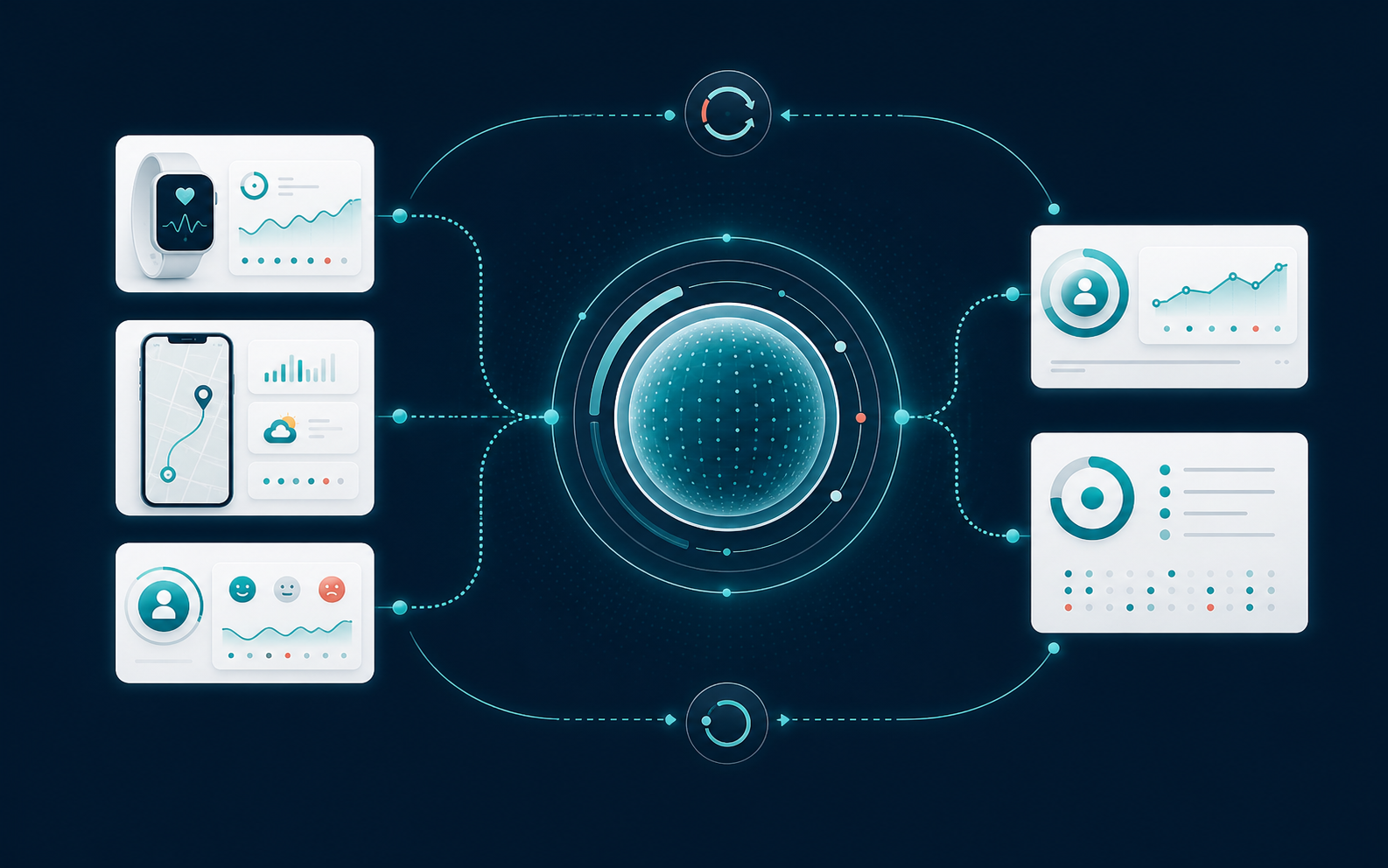
Multimodal digital twin architecture connecting patient signals and clinical insight
01

Wearable signals

Physiological data, movement patterns, sleep quality, and other biometric indicators captured in real-world conditions.
02

Smartphone context

Behavioral and environmental signals that help interpret changes in physiological data.
03

Patient interaction

Symptoms, experiences, and reflections captured actively or through natural interaction.
Integrated intelligence
Signals + context + interaction → patient-specific longitudinal insight
The digital twin of pain

A patient-specific model of pain dynamics

The digital twin is not a static profile or a dashboard. It is a dynamic, patient-specific computational model designed to integrate multimodal inputs and learn how pain changes, what drives it, and how it responds to context and treatment.
Each interaction, signal, and clinical encounter contributes to a richer model of the patient’s pain journey.
Digital twin architecture

IN · Multimodal inputs

Wearable · smartphone · conversational

Pain Digital Twin

Patient-specific learning model

OUT · Longitudinal insight

For patients and clinicians
Responsible development

Built with rigor, transparency, and clinical collaboration

Privacy by design

Privacy, security, and compliance are embedded in the architecture from the start.

Clinical validation

Every component is developed in close dialogue with clinicians and patients.

Epistemic humility

We distinguish validated capability from future potential at every stage.